
7 DAYS HO CHI MINH TRAIL BY MOTORBIKE
Introduction Of 7 Days Ho Chi Minh Trail
Our 7-day Ho Chi Minh Trail motorbike tour is the shortest itinerary for riders who want to experience this legendary route but do not have enough time for a longer adventure. During this journey, we ride on both the modern Ho Chi Minh Road and sections of the historic Ho Chi Minh Trail, following the route through central Vietnam and tracing the history of this famous wartime network.
You may have heard countless stories about the Ho Chi Minh Trail, its role in Vietnam’s history, and the remote landscapes it crossed. Now it is your turn to experience it from the seat of a motorcycle. Rather than simply reading about this historic route, you can ride the Ho Chi Minh Trail yourself, passing through mountains, forests, rural villages, and some of central Vietnam’s most spectacular scenery.
This 7-day Ho Chi Minh Trail motorcycle tour is designed for riders who want a compact but adventurous journey combining history, scenic roads, and authentic rural Vietnam. It includes some long riding days, so a reasonable level of riding experience and fitness is recommended.
Below is a video clip featuring sections of one of our off-road motorcycle tours along the historic Ho Chi Minh Trail. For more riding footage and Vietnam motorcycle adventures, please visit our YouTube channel.
Other Ho Chi Minh Trail Motorcycle Tour Routes
7 Days Ho Chi Minh Trail Motorbike Ride Itinerary
Day 1: Hanoi – Tan Ky (290 km, 9 hours riding)
The 7-day Ho Chi Minh Trail motorcycle tour begins with a long but relatively easy riding day from Hanoi toward Tan Ky. We first leave Hanoi heading south and west, taking a small, scenic, paved road along the western side of the Red River. This quieter route provides an enjoyable introduction to the journey while allowing us to gradually escape the busy capital.
From the Xuan Mai area, we join the modern Ho Chi Minh Highway, which follows the general direction of the historic route through central Vietnam. The road is generally smooth and suitable for making good progress, although the distance makes this a full day in the saddle.
We continue south along the Ho Chi Minh Highway through rural landscapes, passing agricultural areas, villages, and increasingly mountainous scenery before reaching Tan Ky, where we stop for the night.
Overnight: Hotel in Tan Ky.
Day 2: Tan Ky – Phong Nha (280 km, 8 hours riding)
Today is arguably the most demanding riding day of the 7-day Ho Chi Minh Trail motorbike tour, with approximately 280 km of riding. We continue south along the Ho Chi Minh Highway, gradually moving deeper into the landscapes associated with this historic route.
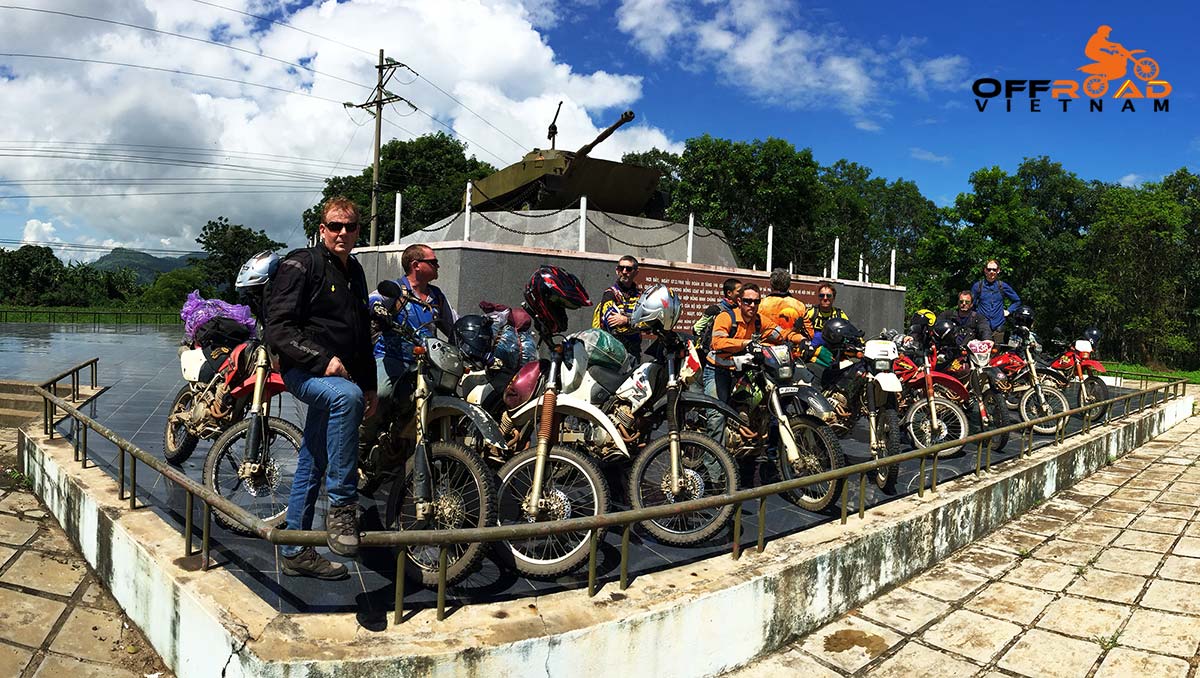
We first ride toward Pho Chau, where we stop to visit a Ho Chi Minh Trail victory monument. This historical stop provides important context for the journey and marks what we consider the real beginning of our exploration of the historic Ho Chi Minh Trail.
From Pho Chau, we continue toward Phong Nha-Ke Bang National Park, following the Ho Chi Minh Highway through remote countryside and mountainous landscapes. The destination is one of the great natural highlights of central Vietnam.
Phong Nha-Ke Bang is famous for its spectacular limestone karst landscape, enormous caves, underground rivers, and extensive cave systems. The area has an extremely long geological history, with karst formations dating back hundreds of millions of years. Today, the national park is recognized as a UNESCO World Heritage Site and is home to some of the most impressive caves and underground landscapes in Vietnam and Southeast Asia.
After a long day following the Ho Chi Minh Trail by motorcycle, we arrive in Phong Nha and settle in for the evening, ready to explore more of this remarkable region on the following stages of the journey.
Day 3: Phong Nha – Dong Hoi (60 km, 2 hours riding)
Today is a shorter riding day, giving us plenty of time to explore the remarkable Phong Nha-Ke Bang World Heritage Site before continuing toward the coast. We take a boat to explore the spectacular caves and underground waterways, while learning about how local civilians and military personnel used these natural formations as shelter during the intense bombing campaigns of the Vietnam War.
After exploring Phong Nha, we get back on the motorcycles and ride down toward Dong Hoi, a coastal city on the shores of the South China Sea. Dong Hoi was heavily bombarded by US warships during the Vietnam War, and the city has since been rebuilt into a relaxed seaside destination.
After arriving, we check into a hotel overlooking the beach. The remainder of the afternoon is free to relax, enjoy the sea views, or simply take some time to recover after the previous long riding day.
Overnight: Hotel in Dong Hoi.
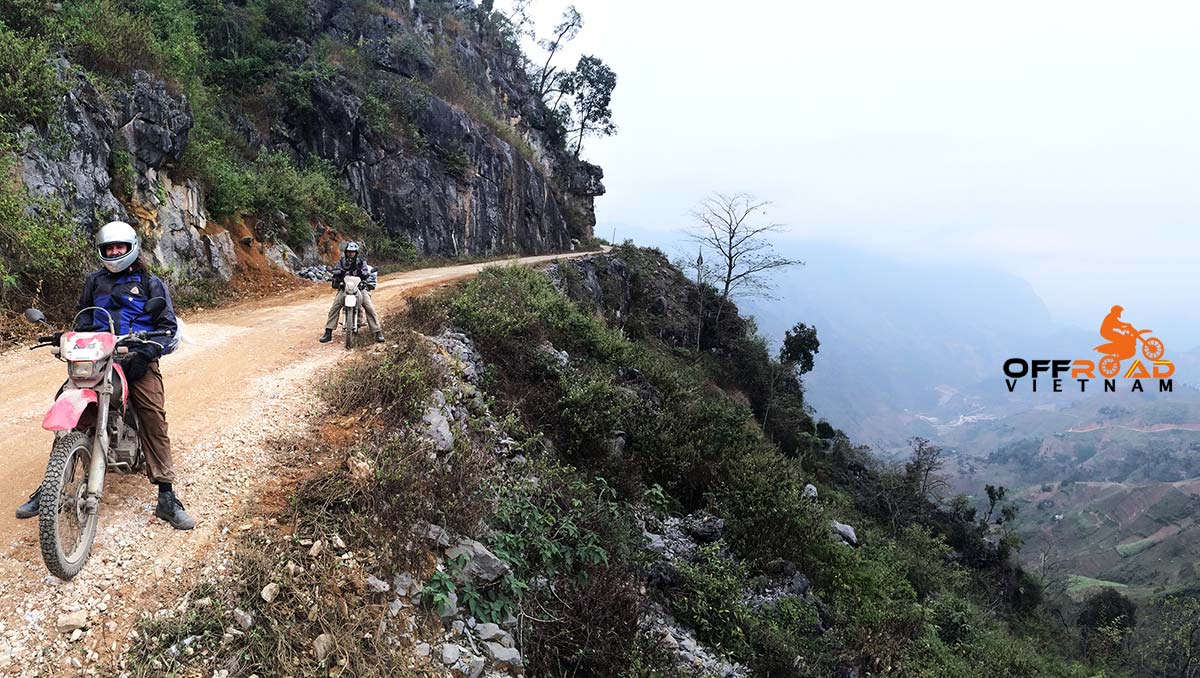
Day 4: Dong Hoi – Khe Sanh (200 km, 6 hours riding)
Today we leave the coast and head south and west toward Khe Sanh, entering one of the most historically significant sections of our Ho Chi Minh Trail motorcycle tour.
The route takes us through the foothills and mountains of central Vietnam, an area that was heavily affected by the Vietnam War. Large areas of the landscape were subjected to bombing and chemical defoliation, including the use of Agent Orange. Even today, there are places where the scars of the war remain visible on the mountainsides and in the surrounding countryside.
As we ride deeper toward the former Demilitarized Zone (DMZ), we occasionally encounter remnants and traces of the original Ho Chi Minh Trail. These sections provide a fascinating connection between the modern road beneath our wheels and the historic wartime network that once crossed these mountains.
Along the way, we visit several important historical sites, including the Vinh Moc Tunnels, an extraordinary underground network where local civilians lived and sheltered during bombing. We also stop at the famous Hien Luong Bridge, located along the former demarcation line between North and South Vietnam.
The journey continues through the Truong Son Cemetery, a major memorial to Vietnamese soldiers who died during the war, before we finally reach Khe Sanh, site of the former US Marine base and one of the best-known battlefields of the Vietnam War.
Overnight: Khe Sanh.
Day 5: Khe Sanh – Hue (180 km, 7 hours riding)
We leave Khe Sanh in the morning and continue south toward the historic A Shau Valley, following mountain roads through some of the most remote landscapes of central Vietnam. We first cross the Da Krong Bridge, originally built with Cuban assistance in 1973, before entering an area that saw intense military activity during the Vietnam War.
The route takes us through the infamous A Shau Valley, passing the area of Hamburger Hill and mountains that still show the long-term effects of wartime defoliation. Some hills remain noticeably barren compared with the surrounding green countryside, providing a powerful reminder of the region’s wartime history.
We continue to A Luoi, an area traditionally inhabited by Bru Van Kieu ethnic communities. From here, the landscape gradually changes as we ride through increasingly green and peaceful countryside, following the road down the steep and winding Me Oi Pass.
After another rewarding day of Ho Chi Minh Trail motorbike riding, we eventually leave the mountains behind and continue toward Hue, the former imperial capital of Vietnam. Located along the beautiful Perfume River, Hue is famous for its imperial history, ancient architecture, and cultural heritage.
Overnight: Hue.
Day 6: Hue – Hoi An (145 km, 5 hours riding)
Day 7: Hoi An. End of 7 Days Ho Chi Minh Trail.
After six days of long-distance riding, today is the most relaxed day of our 7-day Ho Chi Minh Trail motorcycle tour. We spend the entire morning exploring the atmospheric Hoi An Ancient Town, walking through its narrow streets, historic buildings, colorful markets, old merchant houses, temples, and riverside areas.
In the afternoon, you can leave the old town behind and relax at Cua Dai Beach, approximately 6 km from central Hoi An. After the demanding mountain roads, historic battlefields, and long riding days of the previous stages, this is the perfect opportunity to slow down and enjoy the final day of the adventure.
At the end of Day 7, our guide will say goodbye and fly back to Hanoi. From Hoi An, you can continue your independent travels through central and southern Vietnam. You can travel back to Da Nang and continue by train or air, or use one of the many open-bus services connecting Hoi An and Da Nang with destinations farther south, including Ho Chi Minh City.
About Hoi An
The historic town of Hoi An developed around the estuary of the Thu Bon River and was an important trading port in Southeast Asia during the 16th and 17th centuries. Chinese, Japanese, Dutch, Indian, and other foreign merchants settled or traded here, creating a fascinating mixture of cultures and architectural influences.
During the period of international maritime trade, Hoi An was known by different names. It was called Hai Pho in Vietnamese and later became known as Faifo during the French colonial period. One of its most famous landmarks is the Japanese Covered Bridge (Chua Cau), a distinctive covered structure associated with the Japanese merchant community that lived in Hoi An centuries ago.
The historic architecture reflects the town’s long history as an international trading center, with traditional Vietnamese, Chinese, Japanese, and European influences visible throughout the old town.
Present Hoi An
In 1999, Hoi An Ancient Town was recognized as a UNESCO World Heritage Site as an exceptionally well-preserved example of a Southeast Asian trading port dating from the 15th to 19th centuries. Its historic buildings and street layout reflect a unique combination of local traditions and foreign cultural influences.
Today, Hoi An remains a relatively small city but is one of Vietnam’s most popular destinations. Visitors come to explore the atmospheric old town, riverside streets, markets, art galleries, handicraft shops, and famous tailor shops, where visitors can have clothing made to measure.
For riders finishing the Ho Chi Minh Trail by motorcycle, Hoi An provides a particularly rewarding ending: after tracing one of Vietnam’s most important historic routes from the north, crossing remote mountains and former wartime areas, you finish beside the ancient trading streets and beaches of central Vietnam.
Contact us at [email protected] if you have any questions, suggestions, or recommendations regarding this 7-day Ho Chi Minh Trail motorcycle tour in Vietnam.
More Motorcycle Tour Itineraries In Vietnam
- Scenic Ha Giang & Northeast
- North-west Vietnam
- North-east Vietnam
- Central North Vietnam
- Big North Loop of Vietnam
- Mai Chau, Hoa Binh
- One Day Tour Around Hanoi
- Easy Scooter Tours

Hi ! I am interested by your 7 days trip in motorbike from Hanoi to Hoi An, but have two questions about it : do you need to be able to drive an automatic motorbike before the trip or can we learn that just before ? and what would be the price of a 7 days trip ?
Hello Violette. If you never ride motorbikes before then Vietnam is not a good place to start riding. Traffic is crazy and about 27 people die on the road everyday, most are motorcyclists. In addition, we don’t use automatic or even semi-automatic on long trips. It seems you might consider alternative options, fist for your safety. Good luck.